

Interlocking concrete barriers are heavy-duty modular concrete units designed to connect securely to create strong walls, boundaries and protective structures. Their substantial weight, robust construction and flexible layout make them suitable for everything from construction site security and material storage bays to retaining walls and access control.
At Aggregate Superstore, we understand that different sites have very different requirements. Our interlocking concrete barrier blocks provide a practical solution where strength, durability and flexibility are important. They can be used for temporary and permanent structures, allowing businesses to create clear boundaries without necessarily constructing a conventional fixed wall. We have 2 main sizes of blocks, 1600x80x80cm and 1500x60x60cm
Unlike lighter water-filled barriers or temporary fencing, large concrete blocks provide a substantial physical barrier. They can therefore be particularly useful for industrial sites, construction zones, restricted zones, private land and other sensitive areas.
If you’d like something a little more elegant, the interlocking Jersey barriers might be for you.
Interlocking concrete barriers are precast concrete blocks manufactured with profiles that allow individual units to lock against or on top of adjoining blocks.
Think of them as extremely large building blocks. Concrete Interlocking Blocks can be positioned individually or combined to create longer and, where appropriately designed, higher structures.
The engineering principle is relatively straightforward. The substantial weight of the concrete blocks provides resistance to movement, while the interlocking design helps neighbouring units remain correctly positioned.
This combination makes interlocking concrete blocks suitable for boundary walls, site separation, material storage bays, access control and a wide range of infrastructure projects.
The exact performance of any installation depends on the barrier design, ground conditions, configuration, wall height and loads that could be applied to it. Professional assessment is particularly important where retaining walls, flood defence or vehicle impact protection are involved.
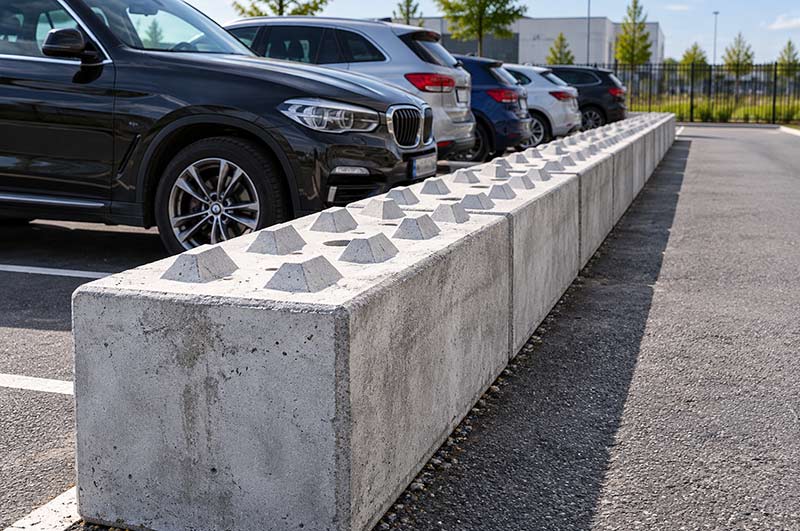
One of the main advantages of interlocking concrete barriers is their versatility.
On construction sites, concrete barriers can be used to establish clear boundaries between vehicles, equipment, pedestrians and working areas. They can also improve construction site security by helping to control site entrances and unauthorised vehicle access.
Industrial and commercial sites can use large concrete blocks to create material storage bays for aggregates, soil, recycled materials and other bulk products. As requirements change, the configuration can potentially be altered rather than a completely new structure being constructed.
Other potential applications include:
Concrete Jersey Barriers and temporary vertical concrete barriers are also widely associated with traffic management and site safety. However, different types of concrete barriers have different designs and intended uses. A barrier designed primarily for demarcation should not automatically be assumed to provide a tested vehicle restraint or impact protection system.
Interlocking concrete barrier blocks are normally produced in controlled moulds, helping manufacturers achieve consistent dimensions and repeatable connection profiles.
Concrete is poured into the mould and allowed to cure until the required strength has developed. Depending on the product and its intended application, reinforcement or specific lifting points may also be incorporated.
Dimensional consistency matters. If the connecting profiles vary significantly, blocks may not align correctly when several units are installed together.
High-strength concrete can also provide excellent durability in demanding commercial and industrial environments. However, buyers should always check the specification of the particular product rather than assuming all concrete security blocks have identical properties.
Good installation starts before the first block arrives.
The site should be assessed for access, drainage, ground conditions and the proposed barrier position. Ground preparation is particularly important when blocks will be stacked or used to retain material.
A suitable base should be level and capable of supporting the substantial weight of the structure.
Individual interlocking concrete blocks are then positioned using appropriate lifting equipment and approved lifting points. Each unit must be carefully aligned before the next barrier is placed.
This process can make installation considerably faster than building a traditional mortared concrete block wall.
However, speed should never replace proper planning. The wall height, soil conditions, drainage requirements, retained material and potential loads should all be considered before installation.
Construction site security is one of the most obvious applications for heavy concrete security blocks.
A fence can define a perimeter, but fencing alone may provide limited resistance to unauthorised vehicle access. Strategically positioned security blocks can provide a much more substantial physical barrier at vulnerable areas.
Concrete barriers may therefore be positioned around site entrances, equipment compounds, vacant land and other sensitive areas.
They can also complement fencing and gates to create layered site security.
When planning access control, however, legitimate vehicle access, emergency access, fire safety and pedestrian movement should all be considered. Simply placing large concrete blocks across an entrance without considering the wider site layout could create additional problems.
Interlocking concrete barriers can also help establish separation between vehicles and other parts of a site.
On larger projects, traffic flow can change as different phases of work are completed. Reusable safety barriers offer flexibility because layouts can potentially be modified as the project develops.
Concrete Jersey Barriers, temporary vertical concrete barriers and other traffic barriers may also be used in high-traffic areas where a clearly defined route is needed.
Where barriers are being used as part of formal highway traffic management or as vehicle restraint systems, appropriate approved products and professional design should be used. Not every physical barrier is automatically a road safety barrier.
Interlocking concrete blocks are particularly useful for creating material storage bays.
Aggregate yards, recycling facilities, construction sites and agricultural businesses often need separate bays for different materials. Interlocking concrete barrier blocks can form strong dividing walls without mortar, allowing the layout to be changed if operational requirements alter.
This can provide a cost-effective solution compared with repeatedly constructing permanent walls.
The correct wall height and block configuration will depend on the material being stored and the forces applied to the wall. A bay storing heavy bulk aggregate, for example, needs to be designed with the lateral pressure of the stored material in mind.
Heavy concrete blocks may also form part of flood defence or water management projects.
They can create physical boundaries or supporting structures, but drainage must be considered carefully. Concrete itself does not solve the wider problem of stormwater management.
Water needs somewhere safe to go.
For this reason, flood defence applications may need to be considered alongside drainage products, ground levels and site-specific engineering requirements.
The main advantages of interlocking concrete barriers include strength, durability and adaptability.
Once correctly installed, their substantial weight makes unauthorised movement difficult without suitable equipment. At the same time, lifting equipment can allow blocks to be deliberately repositioned when a site’s requirements change.
This makes them useful for both a temporary project and larger projects where layouts evolve over time.
Another significant advantage is reusability. Rather than demolishing a conventional wall when it is no longer required, suitable interlocking concrete blocks can potentially be dismantled and used elsewhere.
That can reduce waste and improve the long-term value of the initial investment.
Maintenance requirements are generally low, although blocks should still be inspected for damage, movement or deterioration.
Concrete barriers are extremely heavy, and that strength creates some practical challenges.
Delivery requires suitable transport. Installation requires lifting equipment, and sufficient site access is needed for vehicles and machinery.
Uneven or unsuitable ground can also affect stability.
Project managers should therefore consider:
The minimum order quantity and overall order quantity may also influence delivery costs and pricing. Larger orders can require multiple vehicle movements, so logistics should be discussed at the quotation stage.
The right choice depends on the job.
Water-filled barriers are relatively lightweight when empty and can be convenient for temporary demarcation and crowd control. Concrete barriers offer considerably greater mass and are generally better suited to applications where a substantial physical boundary is required.
For example, event organisers who simply need to guide pedestrians may not require large concrete blocks. A business seeking to restrict vehicle access to private land may require a much more substantial solution.
Selecting barriers should therefore begin with the risk and application, not simply the product price.
The reusable nature of interlocking concrete barriers is one of their practical environmental advantages. A modular barrier can potentially be relocated, reconfigured and reused across multiple projects rather than being demolished after a single installation.
Safe handling remains essential.
Because of their substantial weight, concrete blocks must be moved using suitable equipment and lifting procedures. Workers should remain clear of suspended loads, and lifting points should be checked before movement.
Visibility should also be considered in pedestrian areas, car parks and high-traffic areas. Appropriate signage, lighting or reflective markings may be required depending on the site.
Concrete barriers create a strong physical separation between vehicles, pedestrians, equipment and restricted areas. They can support traffic management, site safety, construction site security and access control. The exact barrier should always be selected according to the risks present on the site.
Concrete Interlocking Blocks combine substantial weight with shaped connecting surfaces. These connections help adjoining blocks remain aligned, while the mass of the concrete provides resistance to movement. Stability also depends on the base, configuration, wall height and loads placed against the structure.
Heavy concrete security blocks can be used to restrict unauthorised vehicle access to private land, construction sites and restricted areas. However, where protection against deliberate vehicle impact is required, a specifically designed and appropriately tested security system should be selected.
Yes. Reusability is one of the main advantages of modular concrete barriers. With suitable lifting equipment, blocks can be removed and repositioned as site requirements change. This makes them attractive for temporary and permanent structures where future flexibility is important.
They can be used for retaining walls, but the structure must be suitable for the intended loading, ground conditions and required wall height. Drainage behind the wall may also be required. Larger retaining structures should be professionally designed.
They can be incorporated into pedestrian areas, but accessibility, visibility and pedestrian routes need careful consideration. The objective should be to create security without introducing unnecessary obstacles or restricting legitimate access.
There is no single barrier configuration that suits every project.
At Aggregate Superstore, we can help customers find interlocking concrete barrier blocks for a wide range of commercial, industrial and construction requirements. Whether you need large concrete blocks for site separation, security barriers, material storage bays, boundary walls or another demanding application, choosing the correct product starts with understanding how it will be used.
Consider the required dimensions, order quantity, delivery access, installation equipment and final configuration before ordering.
Pricing should also be considered in terms of the complete project rather than the individual block alone. Delivery, lifting requirements, installation and the potential to reuse blocks can all affect the long-term value of the solution.
If you need a durable, flexible solution for security, storage, separation or site management, speak to Aggregate Superstore about your specific requirements.
Contact Aggregate Superstore today to discuss interlocking concrete barrier blocks, order quantities, delivery requirements and pricing. Tell us what you need to achieve, and we can help you find a practical solution for your project.
You may also like:
Decorative Boulders for Gardens: Making a natural outdoor space with limestone rocks Decorative boulders can completely change the character of a garden. Whether used as a dramatic focal point, incorporated…
A well-designed limestone border can completely change the appearance of an outdoor space. Whether you are creating defined garden borders around a lawn, separating planting areas from a pathway, or…
20mm clean granite is one of those aggregates that manages to combine practicality with an attractive natural appearance. Strong, hard-wearing and versatile, it can be used for everything from drainage…
At Aggregate Superstore, we help customers choose materials that suit the real demands of their site, not merely a product name. This detailed guide covers clean granite gravel. Our team…
At Aggregate Superstore, we help customers choose materials that suit the real demands of their site, not merely a product name. This detailed guide covers 10mm to dust aggregate. Our…
At Aggregate Superstore, we help customers choose materials that suit the real demands of their site, not merely a product name. This detailed guide covers 6mm clean crushed stone. Our…
Reliable aggregate supplies are the foundation of a well-run construction or landscaping project. The correct stone must perform as intended, arrive in a useful format and reach the site safely….
When a construction project needs a dependable, load-bearing sub-base, 6F5 stone is often one of the most practical choices. This coarse aggregate creates bulk, supports heavy loads and can make…
Decorative aggregates have become one of the most versatile and visually striking materials in modern garden landscaping. From gravel paths to plum slate chippings, they provide colour, texture, and practicality…
Aggregate Superstores’ nationwide delivery service offers customers across the country access to our range of products with fast and reliable shipping.
Aggregate Superstores’ free product samples allow you to try selected items at no cost, helping you to make informed purchasing decisions.